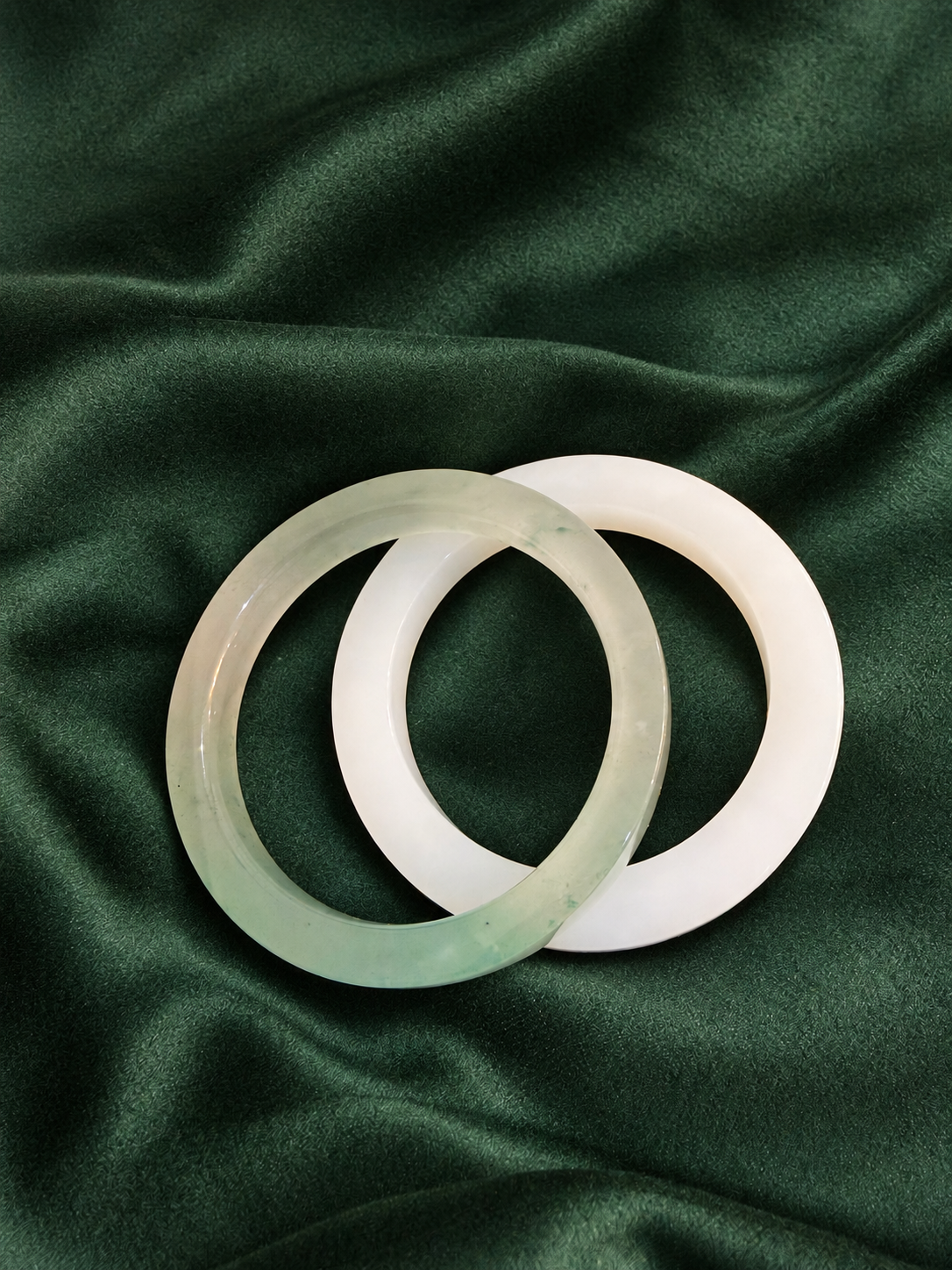
Jadeite value depends on colour, translucency and texture, together with fractures, size, craftsmanship and treatment status. Colour alone does not establish quality: two green stones can differ greatly in structure, appearance and value.
No two pieces of jadeite are exactly alike.
Some are almost transparent, allowing light to travel through their surface. Others reveal soft, cloudy textures or rich, saturated shades of green.
Yet the value of jadeite is not determined by colour alone.
Understanding jadeite begins with recognising the subtle qualities that make each stone unique.
01. Colour — Beyond Green
Green is the most recognised colour of jadeite, but natural jadeite exists in a much broader palette.
From icy white and soft lavender to vivid emerald green, each colour carries its own character.
In evaluating colour, three qualities are particularly important:
- Hue: The character and purity of the colour.
- Saturation: The intensity and richness of the colour.
- Distribution: How evenly the colour appears throughout the stone.
Highly saturated, evenly distributed green jadeite can be exceptionally valuable, particularly when combined with fine texture and high translucency.
However, beauty is not limited to the most expensive shades.
At Jade Aura, we appreciate the understated elegance of softer tones and natural variations.
02. Translucency — The Relationship With Light
One of jadeite’s most captivating qualities is the way it interacts with light.
Some stones appear opaque, while others allow light to penetrate deeply, creating an almost luminous appearance.
In traditional jadeite evaluation, this quality is often associated with water (水头).
Greater translucency can contribute significantly to value, especially when accompanied by a fine internal structure.
But translucency alone does not define quality. Colour, texture and overall harmony remain equally important considerations.
03. Texture — The Beauty Within
Jadeite is composed of interlocking mineral crystals.
The size, arrangement and compactness of these crystals influence its texture and visual appearance.
Fine-grained jadeite often exhibits a smoother, more refined appearance, while coarser structures may appear grainy or cloudy.
A fine, even texture is generally more desirable, particularly in high-quality jewellery.
Natural inclusions and variations are part of the stone’s geological identity. Their impact on value depends on their visibility, location and effect on durability.
04. Clarity — Understanding Natural Imperfections
Unlike diamonds, jadeite is not evaluated through a universally standardised clarity grading system.
Its internal characteristics may include mineral inclusions, colour variations, cloudy areas and fractures.
Some are barely visible. Others become part of the stone’s distinctive appearance.
Fractures that affect structural integrity can reduce value considerably, while minor natural features may have little impact on the overall beauty of a piece.
The key is understanding the difference between natural character and structural weakness.
05. Craftsmanship — Where Material Meets Design
The value of jadeite extends beyond the rough stone.
Cutting, proportion, polishing and craftsmanship all influence the finished piece.
A thoughtful design considers how the stone’s colour, translucency and natural structure interact with its shape.
A well-proportioned piece can reveal the beauty of the material without unnecessary ornamentation.
At Jade Aura, we believe design should complement the stone rather than compete with it.
06. Authenticity — Natural Jadeite and Treatments
When purchasing jadeite, understanding treatments is essential.
In the traditional jadeite trade, three classifications are commonly referenced:
Type A Jadeite
Natural jadeite that has not undergone artificial colour enhancement or resin impregnation. Traditional surface waxing may be present.
Type B Jadeite
Jadeite that has undergone chemical treatment and polymer impregnation to improve its appearance.
Type C Jadeite
Jadeite that has been artificially dyed.
Some jadeite undergoes both B and C treatments.
These classifications describe treatment status, not an overall quality grade. A natural Type A stone is not automatically valuable simply because it is untreated.
For significant purchases, independent gemological testing provides important reassurance about identification and treatment status.
07. Value Is More Than Rarity
The market value of jadeite is shaped by a combination of factors:
Colour. Translucency. Texture. Clarity. Size. Craftsmanship. Authenticity.
Rarity and market demand also play important roles.
Yet the most expensive stone is not necessarily the most meaningful one.
A piece chosen for its proportions, subtle colour and connection to personal style can hold a different kind of value.
At Jade Aura, we see jadeite not simply as a precious material, but as a meeting point between nature and contemporary design.
Defined by form. Remembered through light.
Compare the materials in our jadeite and nephrite guide, then explore stone bead bracelets or the Fine jewellery collection. Each product page identifies its stone and design details.
Further reading: GIA, Jadeite Jade Quality Factors.